
Which Continent in the World Does Not Have a Desert?
How Do Deserts Form?
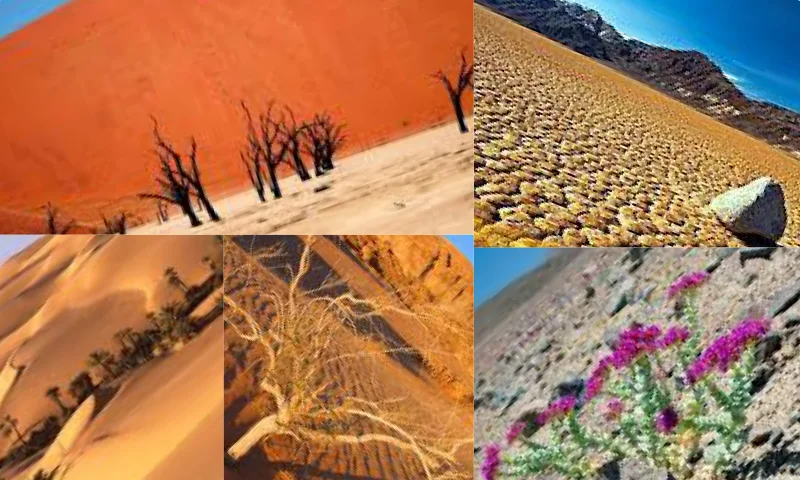
When you hear the word desert, you might imagine vast expanses of sand stretching as far as the eye can see. It's natural to think of this, as it's the most common image. Deserts, along with polar deserts, cover 30% of the Earth's land area. Excluding polar deserts, 28% are semi-arid regions. Deserts are defined as areas that receive less than 250 mm of annual rainfall. Factors contributing to desert formation include high pressure, cold ocean currents, and continental climate. Due to their aridity and low humidity, deserts experience significant temperature differences between day and night. Rainfall is one of the most crucial factors, and its occurrence can vary in deserts. The timing of rainfall is also unpredictable. Despite this, vegetation is not entirely absent and can be found sparsely. There are annual and perennial plants, with cacti being the most well-known example. Just as there are hot and arid deserts, there are also polar deserts in the poles due to extreme cold. While nearly 400 plant species are found in the Arctic, no plant species can be seen in Antarctica.
Types of Deserts and Major Deserts Found Worldwide
Desert areas exist on almost all landmasses in the world. To refresh our general knowledge, we can categorize desert areas into four groups: Continental Interior, Western Coastal, Subtropical, and Polar deserts. Subtropical deserts are arid regions determined by atmospheric currents. Examples include the Sahara Desert, Thar Desert, and Arabian Desert in the Northern Hemisphere along the Tropic of Cancer, and the Kalahari and Australian deserts in the Southern Hemisphere along the Tropic of Capricorn. Continental Interior Deserts form due to their distance from bodies of water, resulting in significant water loss, and often being surrounded by high mountain ranges. Consequently, water vapor turns into precipitation before reaching these areas, making the air arriving here dry. Examples include the Gobi and Taklamakan Deserts in Asia, which are close to each other, and the Patagonian Desert in Argentina, South America. Western Coastal Deserts are so named because they are found on the west coasts of some continents in subtropical regions. We can cite the deserts of North America and the Atacama Desert in Chile, South America, as examples. Polar Deserts, as the name suggests, are the extremely cold and arid regions of Greenland and Antarctica in the North. Here, temperatures never rise above freezing, so snow does not melt. In Antarctica, the precipitation rate, equivalent to 50 mm of rain, is less than that of snow. We have discussed desert types and their locations. Deserts form in specific areas across almost all continents. There are five continents in the world: Africa, Europe, Asia, Australia, and Antarctica. However, the continent of Europe, located in the Northern Hemisphere and corresponding to the Tropic of Cancer, does not have any deserts.